Classic & Classic-Style Maps
Posted: Sat Aug 07, 2010 3:37 pm
Classic & Classic-Style Maps
Map by sully800
Guide by stahrgazer with thanks to Robinette and the Strategy Guides Project team for their assistance.
Introduction
The Classic map reflects six of the main landmasses of the world with major cities as region names. Hold each region (city) of a bonus zone (landmass) at the start of the turn for the zone bonus indicated in the legend, the series of small globes along the bottom of the map.
Some players might be interested to know that this map is the last in a Classic progression. The first "Classic globe" map was replaced with two "Classic cube" maps: one with obscure Artsy names, another with geometrical Shapes; each with the same play-pattern. The Classic Shapes map was converted into the Society of the Cooks’ Strategy Training Map when, after a long and intense foundry process, Conquer Club settled on this aesthetic, "globe" map with cities of the world represented as regions. Older members occasionally reminisce about "the good ol' Classic," meaning the original "Classic globe" map from Conquer Club's launch.
At 42 regions and 6 traditional bonus zones, the Classic map offers sufficient strategic challenge for those who want to risk the agony of defeat for the thrill of victory against one or many opponents using a variety of the game options Conquer Club offers.
With no alternative victory conditions - that can be found on some Conquer Club maps - the only way to win on the Classic map is to assault and conquer every opponent. The exception to this is Assassin, where one need only eliminate that one opponent to win the game.
How to play Classic
Classic is fun for two to eight players, whether the setup is:
In general, go with automatic deployments; but you might want to opt for manual deployments sometimes in games with four or more players.
Flat rate or escalating spoils each offer pros and cons; players will argue vehemently as to which is best. For multiplayer (1 v. all) games, the option of choice is usually escalating, if for no other reason than to ensure the game ends rather than stalemates. No spoils, especially for team games; and nuclear spoils; offer chances to experiment with alternative strategies so that the same map becomes an entirely new game. On the Classic map, spoils are generally a matter of preference.
Fog of war is not necessary to Classic, but it is unique to online games and adds some spice. As personal preference, I do recommend the setting.
Conquer Club game options can change the strategy required to win. Rather than restrict yourself to just your comfort zone, have fun, experiment with all the varieties of game options. Classic is a versatile map!
Map by sully800
Guide by stahrgazer with thanks to Robinette and the Strategy Guides Project team for their assistance.
- Click image to enlarge.
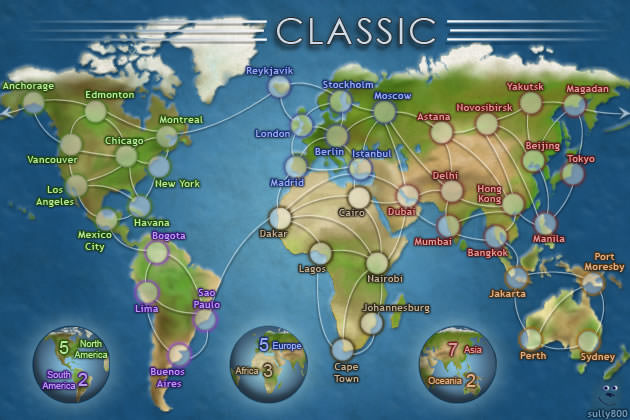
The Classic map reflects six of the main landmasses of the world with major cities as region names. Hold each region (city) of a bonus zone (landmass) at the start of the turn for the zone bonus indicated in the legend, the series of small globes along the bottom of the map.
Some players might be interested to know that this map is the last in a Classic progression. The first "Classic globe" map was replaced with two "Classic cube" maps: one with obscure Artsy names, another with geometrical Shapes; each with the same play-pattern. The Classic Shapes map was converted into the Society of the Cooks’ Strategy Training Map when, after a long and intense foundry process, Conquer Club settled on this aesthetic, "globe" map with cities of the world represented as regions. Older members occasionally reminisce about "the good ol' Classic," meaning the original "Classic globe" map from Conquer Club's launch.
At 42 regions and 6 traditional bonus zones, the Classic map offers sufficient strategic challenge for those who want to risk the agony of defeat for the thrill of victory against one or many opponents using a variety of the game options Conquer Club offers.
Classifications - Size, Features, and Complexity
Size: Medium, 42 regions
Complexity: Simple
Features: None
Bonuses: Medium. One or more players can get a zone bonus with the random drop.
Bonus Zones by Bonus Value
Complexity: Simple
Features: None
Bonuses: Medium. One or more players can get a zone bonus with the random drop.
Bonus Zones by Bonus Value
- Asia – 12 Regions, Bonus 7
- North America – 9 Regions, Bonus 5
- Europe – 7 Regions, Bonus 5
- Africa – 6 Regions, Bonus 3
- South America – 4 Regions, Bonus 2
- Oceania – 4 Regions, Bonus 2
How to play Classic
How to play Classic-Style Maps
Assault Considerations
If an opponent is dropped onto an initial bonus zone or almost all of a bonus zone, a player is usually wise to break the zone bonus or lessen the opponent’s chances of taking the zone bonus. There are times, however, when taking your own bonus zone for the troop advantage could be more critical. This is especially true if the bonus zone you take is easy to defend, while the opponent’s bonus zone is less secure.
Bonus Defense Considerations
The ability to defend a bonus is an important point to selecting which bonuses to strive for. A player might, for example, think that taking and holding any smaller bonus zone is easier than taking a larger bonus zone. For Oceania and South America on the Classic map, that may be true. Find discussion of Oceania and South America under two-player strategy. The same “smaller is easier” logic does not work for all bonus zones.
To get the zone’s troop bonus, the player must hold every region plus control (hold or strongly defend against) every exterior assault region that could break the bonus zone at interior assault regions. Players may find it easier to defend and hold a larger bonus zone with less interior or exterior assault regions, than to hold a smaller bonus zone that has a greater number of vulnerable regions.
To understand this point, take a look at the following table, an analysis of the Classic Map Bonus Zones by Assault Points. The bonus zones are listed in the order of “easiest to defend” based on interior and exterior assault regions.
Classic Map Bonus Zones by Assault Points
Bonus Zone--------Regions---Interior---Exterior---Shielded---Bonus
Oceania-----------------4-----------1-----------1----------3-----------2
South America---------4-----------2------------2----------2-----------2
North America---------9-----------3------------3----------6-----------5
Africa-------------------6-----------3------------4----------3-----------3
Europe------------------7-----------4------------6----------3-----------5
Asia--------------------12-----------5------------6----------7-----------7
North America has more regions, so seems "harder to hold" at first glance. Look again. Comparing North America to Europe, each can provide a +5 bonus, but North America has less areas to defend from exterior assaults, many shielded regions that can reinforce the front.
Balance the idea of taking a larger, more defensible region with the knowledge that an opponent will try harder to break a +5 than a +3 bonus zone.
When going after a zone bonus, remember to keep an eye on your expansion options. You will not want to get 'trapped' or 'dead-ended'--- cornered into one bonus zone with no regions outside that zone. Try to keep sufficient troops on regions outside of a bonus zone so you do not get cornered.
Reach
With one's bonus firmly in hand and no current opponent bonus zone to break, the player should:
Remember, preventing opponent(s) from gaining bonus troops should be a general priority; but holding bonus zones are not the only way to gain additional troops on Classic-style maps.
Region Count Advantage
The troops received at the start of a turn are based on region count; the player receives an additional troop to deploy for every three regions above nine. While this is not specifically a bonus, it can work like a bonus.
Reinforcements
Conquer Club offers three options for the movement of troops from one or more regions to other owned or teammate-owned regions, for defense or assault in the next round.
The newer player may be uncomfortable venturing into the ‘blind’ play that fog of war appears to offer, but Classic-style games with fog of war are easier than it first seems; and probably offer more advantages than disadvantages for the newer player.
In fog of war, the opponent is unlikely to be absolutely certain where the player is, or after a few rounds, cannot be certain how strong a player is behind the front lines. The newer player’s potential errors can be more concealed than with a no-fog game.
Count Visible and Invisible Regions
How many regions does the player own? If no regions have been conquered by any player, all players have the same number of regions. The player can count visible opponent regions and make a reasoned estimate as to how many of the Fog ? regions the opponent holds within a bonus zone. Estimate on the side of caution.
If the player can see only one region in a bonus zone from an adjacent region and the opponent has enough invisible regions to be holding the bonus zone; then make the assumption that the opponent holds all of that bonus zone and act accordingly.
Check the Game Log
If the opponent has taken a turn, the log will reveal that the opponent received a zone bonus: +2 for holding ? but will not indicate which specific bonus zone was held. If you hold any region of another bonus zone that would yield the same bonus; or if the map offers only one bonus zone for that number of troops, then by default you know which bonus zone your opponent holds. If the opponent took a turn, received no bonus, and conquered no region, the player knows the opponent does not yet hold all of a bonus zone.
The game choices that fog of war makes the most challenging are Assassin and Terminator. Unless the player is adjacent to the target (Assassin) or choice for elimination (Terminator) the player will find more of a challenge to figure out where to strike. In that case, notes from prior rounds can be helpful. “When I held region x, I could see that Opponent A held region y; so if I strike from region z, I have a good chance of finding Opponent A’s remaining regions.”
Fog of war is not necessary for Classic-style maps, but is highly recommended to add to the fun available on Conquer Club.
Deployments
Conquer Club offers the choice of Manual or Automatic deployments for Round 1.
Multiplayer games require additional strategic questions. Okay, you can ask these questions in other settings, too... but the questions are more critical for multiplayer games.
In flat rate or no spoils games, strategy after the initial turns often revolves around maintaining a balance between players through assaults and diplomacy and deciding when best to break that balance to your advantage. Nuclear spoils can break any balance, since any player could annihilate a region far beyond the reach of owned regions. Since players cannot count on holding a bonus and any troop stacks could be demolished, luring the player to take a region you are about to nuke, diplomacy, and striving for a region count advantage are good tactics for nuclear spoils.
More opponents and less starting regions can increase risk of losing, but the points gained if the player wins can make this risk worthwhile. Be prepared to set objectives well in advance and move slowly toward them.
Team Games
Remember Hannibal from the A-Team? “I love it when a plan comes together!” Team with one to three other players to defeat opposing forces and find out how well you can work with the team to plan and execute a strategy or series of strategies.
The main unique choice in team games is whether to assault a teammate for a bonus or forgo the bonus to keep the mate safe from enemy assault. With spoils, especially escalating spoils, sacrificing part of the team for the greater good can be a viable strategy.
A common strategy in team games is to target one opponent for elimination, and stack troops on one teammate to carry out the plan. Troop stacks can also be used to break or take a bonus zone, or protect a teammate from elimination. Like 1v1 games, in no spoils or smaller team games, conquering a bonus zone is often a strategic goal in Classic-style maps. Another goal for smaller team games is obtaining a region count advantage – remember, these can work like small bonuses.
In quads games, with fewer regions per player, nominate an opponent for elimination early in the game – one you need to remove anyway (like to protect a bonus zone) or one who is exposed to assaults from many members of your team, who does not have territories protected by his/her own teammates, .
Terminator Games
Conquer Club offers terminator games: players receive points for a partial win by eliminating any opponent. With this setting, even if dropped away from those juicy bonus zones, the player may be fortunate enough to take out an opponent’s last region, gaining points even if the player is now too weak to withstand opponent who was able to hold a bonus or retain assault strength. With more players, each player has a greater chance of eliminating someone despite starting with fewer regions; and someone lucky enough to run all or most of the map will win a whopping amount of points.
Assassin
With Assassin games, winning could be less dependent on bonuses and more dependent on player arrangement. If a player is initially dropped right beside the target opponent, the player has a better chance of victory, especially if the other opponents’ targets require clearing the board to reach them. A detriment to this, of course, is that if the target or other opponents get a clear idea of who the player has in crosshairs, they will all do what they can to prevent the player from eliminating the opponent, using their troops to block. Generally, Assassin will be more fun with more players, because the need to play strategically is greater.
- Break or prevent opponent from gaining zone bonus
- Take or protect zone bonus
- Take a region with long reach for future assaults or block tactics
If an opponent is dropped onto an initial bonus zone or almost all of a bonus zone, a player is usually wise to break the zone bonus or lessen the opponent’s chances of taking the zone bonus. There are times, however, when taking your own bonus zone for the troop advantage could be more critical. This is especially true if the bonus zone you take is easy to defend, while the opponent’s bonus zone is less secure.
Bonus Defense Considerations
The ability to defend a bonus is an important point to selecting which bonuses to strive for. A player might, for example, think that taking and holding any smaller bonus zone is easier than taking a larger bonus zone. For Oceania and South America on the Classic map, that may be true. Find discussion of Oceania and South America under two-player strategy. The same “smaller is easier” logic does not work for all bonus zones.
To get the zone’s troop bonus, the player must hold every region plus control (hold or strongly defend against) every exterior assault region that could break the bonus zone at interior assault regions. Players may find it easier to defend and hold a larger bonus zone with less interior or exterior assault regions, than to hold a smaller bonus zone that has a greater number of vulnerable regions.
To understand this point, take a look at the following table, an analysis of the Classic Map Bonus Zones by Assault Points. The bonus zones are listed in the order of “easiest to defend” based on interior and exterior assault regions.
Classic Map Bonus Zones by Assault Points
Bonus Zone--------Regions---Interior---Exterior---Shielded---Bonus
Oceania-----------------4-----------1-----------1----------3-----------2
South America---------4-----------2------------2----------2-----------2
North America---------9-----------3------------3----------6-----------5
Africa-------------------6-----------3------------4----------3-----------3
Europe------------------7-----------4------------6----------3-----------5
Asia--------------------12-----------5------------6----------7-----------7
North America has more regions, so seems "harder to hold" at first glance. Look again. Comparing North America to Europe, each can provide a +5 bonus, but North America has less areas to defend from exterior assaults, many shielded regions that can reinforce the front.
- Europe requires control of 13 regions.
....7 regions; three shielded - use to reinforce four interior assault regions.
....Must defend against 6 exterior assault regions. - North America requires control of 12 regions.
....9 regions; six shielded - use to reinforce three interior assault regions.
....Must defend against 3 exterior assault regions.
Balance the idea of taking a larger, more defensible region with the knowledge that an opponent will try harder to break a +5 than a +3 bonus zone.
When going after a zone bonus, remember to keep an eye on your expansion options. You will not want to get 'trapped' or 'dead-ended'--- cornered into one bonus zone with no regions outside that zone. Try to keep sufficient troops on regions outside of a bonus zone so you do not get cornered.
Reach
With one's bonus firmly in hand and no current opponent bonus zone to break, the player should:
- Target regions that are exterior assault points for one's bonus zone
- Target long-reach that can assault into other bonus.
- Target regions that can assault into a region where the opponent is massing strength.
Remember, preventing opponent(s) from gaining bonus troops should be a general priority; but holding bonus zones are not the only way to gain additional troops on Classic-style maps.
Region Count Advantage
The troops received at the start of a turn are based on region count; the player receives an additional troop to deploy for every three regions above nine. While this is not specifically a bonus, it can work like a bonus.
- Player start: 14 regions (4 troops), conquers two = 16 regions (5 troops).
- Opponent start: 12 regions (4 troops); conquers one = 13 regions (4 troops)
- Player Round 2: 15 regions (5 troops); conquer two =17 regions (5 troops)
- Opponent round 2: 11 regions (3 troops)
Reinforcements
Conquer Club offers three options for the movement of troops from one or more regions to other owned or teammate-owned regions, for defense or assault in the next round.
- Adjacent – move troops to a region that touches.
----Can slow the play.
----Can add the need to plan assaults more carefully because of reinforcement restrictions. - Chained – move troops from one region to another in an unbroken string.
----Can be a happy medium between strategic planning and troop movement.
----Recommended for most games, especially for the newer player. - Unlimited –move troops as many times as desired, along several chains.
----Not recommended for 2-player or 2-team doubles games.
----Play can be highly unbalanced in favor of the first player or team to play.
----This problem is lessened if the first team/player must defend or assault in multiple directions.
----Can be fun for multiplayer, triples, quads, and 3-team doubles games.
The newer player may be uncomfortable venturing into the ‘blind’ play that fog of war appears to offer, but Classic-style games with fog of war are easier than it first seems; and probably offer more advantages than disadvantages for the newer player.
In fog of war, the opponent is unlikely to be absolutely certain where the player is, or after a few rounds, cannot be certain how strong a player is behind the front lines. The newer player’s potential errors can be more concealed than with a no-fog game.
Count Visible and Invisible Regions
How many regions does the player own? If no regions have been conquered by any player, all players have the same number of regions. The player can count visible opponent regions and make a reasoned estimate as to how many of the Fog ? regions the opponent holds within a bonus zone. Estimate on the side of caution.
If the player can see only one region in a bonus zone from an adjacent region and the opponent has enough invisible regions to be holding the bonus zone; then make the assumption that the opponent holds all of that bonus zone and act accordingly.
Check the Game Log
If the opponent has taken a turn, the log will reveal that the opponent received a zone bonus: +2 for holding ? but will not indicate which specific bonus zone was held. If you hold any region of another bonus zone that would yield the same bonus; or if the map offers only one bonus zone for that number of troops, then by default you know which bonus zone your opponent holds. If the opponent took a turn, received no bonus, and conquered no region, the player knows the opponent does not yet hold all of a bonus zone.
The game choices that fog of war makes the most challenging are Assassin and Terminator. Unless the player is adjacent to the target (Assassin) or choice for elimination (Terminator) the player will find more of a challenge to figure out where to strike. In that case, notes from prior rounds can be helpful. “When I held region x, I could see that Opponent A held region y; so if I strike from region z, I have a good chance of finding Opponent A’s remaining regions.”
Fog of war is not necessary for Classic-style maps, but is highly recommended to add to the fun available on Conquer Club.
Deployments
Conquer Club offers the choice of Manual or Automatic deployments for Round 1.
- Automatic deployments, where the computer assigns 3 troops per owned region, are fun for any game on Conquer Club map.
- Manual Deployments, where the computer assigns one troop to hold a region, and in Round 1 each player is given the balance that would enable the normal 3-per-region to deploy at will. In other words, each player gets troops to deploy based on twice the number of starting regions.
Manual Deployments are not generally recommended for Classic-style games of 1v1 or with only a few players; the large stacks can decide the game in Round 1.The potential to overwhelm opponents with the first strike exists, but is lessened, with more players. Manual deployments are less likely to decide the game on very large maps with a substantial quantity of neutral starting regions.
- Flat Rate. With few players, the first mixed-set cash (10 troops) is unlikely to significantly affect games on mid-size and larger maps; a player will not sweep the board with ten troops. With more players, a first 10-cash may enable taking bonuses or eliminating an opponent.
- Escalating. Sweeping the board is quite possible with escalating spoils, once enough sets are turned in to enable 20 or 30 troops. Many multiplayer games with escalating spoils are decided by targeting one opponent for spoils, cashing again and eliminating a next opponent for more cashes in the same turn. Mid-turn cashing occurs when the player wins enough spoils from opponents to hold 5 spoils.
- No Spoils. No spoils can require players to make sound strategic plans - with no spoils, there is little forgiveness for error - but in games with few players where the game’s random drop lands a player on all the regions in a bonus zone at game start, the game can either be decided in early rounds, or players stack troops for rounds in a row before making assaults. Without spoils, random drop and intensity cubes luck (good or bad) are emphasized, especially with fewer players. The player dropped onto an entire bonus zone – gaining an initial +2 troops bonus - is more likely to keep it; especially if that player gets the first chance to make assaults and reinforce.
- Nuclear Spoils. In one of the unique settings offered on Conquer Club, a player might be forced to nuke a bonus or get to nuke an opponent’s troop stack or bonus. This changes the strategy emphasis from high-troop protection at borders – at least when cashes are imminent - to assault thrusts for a region count advantage. Nuclear spoils also offers the chance to bait and lure; it can be fun to get the opponent to assault a specific region just so the player can nuke that region to a neutral in the next turn.
Multiplayer games require additional strategic questions. Okay, you can ask these questions in other settings, too... but the questions are more critical for multiplayer games.
- Take a bonus or eliminate a player? Eliminate an opponent unless doing so weakens the player, giving a third opponent an advantage.
- Assault or block an assault? You may have insufficient troops to take out an opponent, but can you place what you do have to prevent an opponent from taking out one of the other players?
In flat rate or no spoils games, strategy after the initial turns often revolves around maintaining a balance between players through assaults and diplomacy and deciding when best to break that balance to your advantage. Nuclear spoils can break any balance, since any player could annihilate a region far beyond the reach of owned regions. Since players cannot count on holding a bonus and any troop stacks could be demolished, luring the player to take a region you are about to nuke, diplomacy, and striving for a region count advantage are good tactics for nuclear spoils.
More opponents and less starting regions can increase risk of losing, but the points gained if the player wins can make this risk worthwhile. Be prepared to set objectives well in advance and move slowly toward them.
Team Games
Remember Hannibal from the A-Team? “I love it when a plan comes together!” Team with one to three other players to defeat opposing forces and find out how well you can work with the team to plan and execute a strategy or series of strategies.
The main unique choice in team games is whether to assault a teammate for a bonus or forgo the bonus to keep the mate safe from enemy assault. With spoils, especially escalating spoils, sacrificing part of the team for the greater good can be a viable strategy.
A common strategy in team games is to target one opponent for elimination, and stack troops on one teammate to carry out the plan. Troop stacks can also be used to break or take a bonus zone, or protect a teammate from elimination. Like 1v1 games, in no spoils or smaller team games, conquering a bonus zone is often a strategic goal in Classic-style maps. Another goal for smaller team games is obtaining a region count advantage – remember, these can work like small bonuses.
In quads games, with fewer regions per player, nominate an opponent for elimination early in the game – one you need to remove anyway (like to protect a bonus zone) or one who is exposed to assaults from many members of your team, who does not have territories protected by his/her own teammates, .
Terminator Games
Conquer Club offers terminator games: players receive points for a partial win by eliminating any opponent. With this setting, even if dropped away from those juicy bonus zones, the player may be fortunate enough to take out an opponent’s last region, gaining points even if the player is now too weak to withstand opponent who was able to hold a bonus or retain assault strength. With more players, each player has a greater chance of eliminating someone despite starting with fewer regions; and someone lucky enough to run all or most of the map will win a whopping amount of points.
Assassin
With Assassin games, winning could be less dependent on bonuses and more dependent on player arrangement. If a player is initially dropped right beside the target opponent, the player has a better chance of victory, especially if the other opponents’ targets require clearing the board to reach them. A detriment to this, of course, is that if the target or other opponents get a clear idea of who the player has in crosshairs, they will all do what they can to prevent the player from eliminating the opponent, using their troops to block. Generally, Assassin will be more fun with more players, because the need to play strategically is greater.
- Two player (1v1)
- Multiplayer (1vAll – the player against 2 to 7 opponents)
- Terminator
- Assassin
- 2 to 4 Doubles teams
- 2 Triples teams
- 2 Quads teams
In general, go with automatic deployments; but you might want to opt for manual deployments sometimes in games with four or more players.
Flat rate or escalating spoils each offer pros and cons; players will argue vehemently as to which is best. For multiplayer (1 v. all) games, the option of choice is usually escalating, if for no other reason than to ensure the game ends rather than stalemates. No spoils, especially for team games; and nuclear spoils; offer chances to experiment with alternative strategies so that the same map becomes an entirely new game. On the Classic map, spoils are generally a matter of preference.
Fog of war is not necessary to Classic, but it is unique to online games and adds some spice. As personal preference, I do recommend the setting.
Conquer Club game options can change the strategy required to win. Rather than restrict yourself to just your comfort zone, have fun, experiment with all the varieties of game options. Classic is a versatile map!
Two Player
With 14 starting regions enabling 4 troop deployments, unless the player is dropped a zone bonus, reducing the opponent to 11 regions in round 1 is improbable. A better strategy, then, is to consider smaller bonuses.
With the random drop and no regions restricted to start as neutral regions, a balanced, “fair to all players” drop is not assured on this map. A highly improbable scenario, but possible (so worth mentioning) is that a single player can receive 3 bonus zones on the drop: Africa, South America, and Oceania, (14 starting regions; 6, 4, and 4 regions per bonus zone respectively). In other words, a player may begin the game with an initial troop advantage because of one or more zone bonuses, and this can greatly affect two-player games.
More likely a player will receive all or most of one of the continents, with the opponent also receiving all or most of one of the continents, and the rest spread throughout.
If the player has three Oceania regions and holds Bangkok, while the opponent has all of South America (both 4-region continents with +2 bonuses) taking the Oceania bonus zone first could be wise. Bangkok is the only entry into Oceania, so the player can reinforce any additional troops forward from the three shielded regions to gain the zone bonus. If the zone is held for the start of the next round, the additional bonus troops can be used to break South America, especially if the player has some strength at or near Dakar or Mexico City.
The reverse is not necessarily true. If the opponent holds Oceania and the player has the choice of taking South America or breaking Oceania, the player may wish to break Oceania rather than focus on obtaining the South America bonus. Preventing the opponent from taking Oceania with strength is recommended; Oceania is the only continent with just one exterior assault region, so is easier to defend once entrenched. Recalling the table under the Bonus Defense Considerations, holding Oceania requires control of 5 regions with the ability to fort three shielded regions forward; holding South America requires control of 6 regions with only two shielded regions.
Expansion
In addition to gaining bonuses, the player must consider where to focus future assaults. There are no dead ends on the Classic map, but there are interior and exterior Regions.
Plan moves that enable you to expand. While Oceania is a small but juicy prize, once you hold it, where will you go? Asia is hard to hold; the player who holds Oceania will often strike west toward Africa or Europe, despite their distance. Typically, a player who holds either North or South America will seek to expand into the other American continent, as an extra bonus zone can be held with the addition of no more or only few more interior and exterior assault regions.
With one's bonus firmly in hand and no current opponent Bonus Zone to break, the player should:
These regions assault into multiple other bonus zones.
With the random drop and no regions restricted to start as neutral regions, a balanced, “fair to all players” drop is not assured on this map. A highly improbable scenario, but possible (so worth mentioning) is that a single player can receive 3 bonus zones on the drop: Africa, South America, and Oceania, (14 starting regions; 6, 4, and 4 regions per bonus zone respectively). In other words, a player may begin the game with an initial troop advantage because of one or more zone bonuses, and this can greatly affect two-player games.
More likely a player will receive all or most of one of the continents, with the opponent also receiving all or most of one of the continents, and the rest spread throughout.
If the player has three Oceania regions and holds Bangkok, while the opponent has all of South America (both 4-region continents with +2 bonuses) taking the Oceania bonus zone first could be wise. Bangkok is the only entry into Oceania, so the player can reinforce any additional troops forward from the three shielded regions to gain the zone bonus. If the zone is held for the start of the next round, the additional bonus troops can be used to break South America, especially if the player has some strength at or near Dakar or Mexico City.
The reverse is not necessarily true. If the opponent holds Oceania and the player has the choice of taking South America or breaking Oceania, the player may wish to break Oceania rather than focus on obtaining the South America bonus. Preventing the opponent from taking Oceania with strength is recommended; Oceania is the only continent with just one exterior assault region, so is easier to defend once entrenched. Recalling the table under the Bonus Defense Considerations, holding Oceania requires control of 5 regions with the ability to fort three shielded regions forward; holding South America requires control of 6 regions with only two shielded regions.
Expansion
In addition to gaining bonuses, the player must consider where to focus future assaults. There are no dead ends on the Classic map, but there are interior and exterior Regions.
Plan moves that enable you to expand. While Oceania is a small but juicy prize, once you hold it, where will you go? Asia is hard to hold; the player who holds Oceania will often strike west toward Africa or Europe, despite their distance. Typically, a player who holds either North or South America will seek to expand into the other American continent, as an extra bonus zone can be held with the addition of no more or only few more interior and exterior assault regions.
With one's bonus firmly in hand and no current opponent Bonus Zone to break, the player should:
- Target regions that are exterior assault points for one's bonus zone (Jakarta conquer Bangkok)
- Target long-reach regions that can assault into multiple bonus zones.
- Target regions that can assault into a continent where the opponent is massing strength.
- Target regions that enable the player to gain and keep a substantive region count advantage.
These regions assault into multiple other bonus zones.
- Dakar (Africa): reaches South America and Europe
- Cairo (Africa): reaches Asia and Europe
- Dubai (Asia): reaches Africa and Europe
- Istanbul (Europe): reaches Africa and Asia
- Chicago (Edmonton, Montreal, New York, Havana, Los Angeles, Vancouver)
- Dubai (Delhi, Mumbai, Nairobi, Cairo, Istanbul, Moscow)
- Istanbul (Madrid, Berlin, Moscow, Dubai, Cairo, Dakar)
- Moscow (Istanbul, Berlin, Stockholm, Astana, Delhi, Dubai)
- Nairobi (Johannesburg, Capetown, Lagos, Dakar, Cairo, Dubai)
- Hong Kong (Bangkok, Mumbai, Delhi, Astana, Novosbirsk, Manila)
Multiplayer
The game is large enough to support up to 8 players all vying to conquer the map, and 8-player freestyle (where everyone can play the round at once, rather than in a specific order) is a popular setting for this map. Still, fewer players on this map – such as six - might offer more balanced play.
# Players......Start Regions
Remember the value of regions like Dubai, which reaches into two other bonus zones (Africa and Europe) and six city regions: Delhi, Mumbai, Nairobi, Cairo, Istanbul, and Moscow. In games with more players, long reach regions are particularly important.
# Players......Start Regions
- 2.............14
- 3.............14
- 4.............10
- 5..............8
- 6..............7
- 7..............6
- 8..............5
Remember the value of regions like Dubai, which reaches into two other bonus zones (Africa and Europe) and six city regions: Delhi, Mumbai, Nairobi, Cairo, Istanbul, and Moscow. In games with more players, long reach regions are particularly important.
Team Games
While trips or quads games are limited to two teams, the game will support up to four doubles teams. More opponents mean a greater chance for early elimination – the player, a teammate, or one of the opposition; because the number of starting regions is less.
Number of Players...............Start Regions
Because they are easier to defend, Oceania and South America are the preferred bonus zone targets, so the easiest choices for elimination are the opponents who hold regions in those landmasses. In general, teams will try to reinforce their teammates in those areas, or in other long-reach regions on the map.
Number of Players...............Start Regions
- Two-Team Doubles.............10
- Three-Team Doubles.............7
- Two-Team Triples................7
- Four-Team Doubles..............5
- Two-Team Quads................5
Because they are easier to defend, Oceania and South America are the preferred bonus zone targets, so the easiest choices for elimination are the opponents who hold regions in those landmasses. In general, teams will try to reinforce their teammates in those areas, or in other long-reach regions on the map.
Terminator and Assassin
Playing with either of these settings is fun on the Classic map. The strategies for these variations are fairly generic; based on number of regions, types of spoils, and where the random drop starts the players rather than dependent on the map itself. Like in team and other multiplayer games, take care not to over-assault so that you become a weak target. Make “stay strong” a priority over “take bonus zones.”
Manual Deployments
Manual Deployments are a viable option for reasonably balanced Classic play for games with four to eight players; whether individual or teams.
- Two Player: 28 troops (14 Regions)
- Three Player: 28 troops (14 Regions)
- Four Player or Two-Team Doubles: 20 troops (10 Regions)
- Five Player: 16 troops (8 Regions)
- Six Player or Three-Team Doubles: 14 troops (7 Regions)
- Seven Player: 12 troops (6 Regions)
- 8-player or Two-Team Quads: 10 troops (5 Regions)
Similar Maps
Players who enjoy Classic might enjoy some of these similar maps on Conquer Club.The foundry is constantly working on new maps, so this list is by no means complete!
- Asia - Same size, new play.
- Canada - Same size, new play.
- Japan - Adds a twist to a same-size map with 1 dead space (not part of bonus zone) region.
- Alexander's Empire - An extra bonus zone and more dead space regions.
- France - Only slightly larger than Classic at 44 regions, 7 bonus zones.
- CCU - Same size as France, with 2 dead space regions.
- 13 Colonies - 44 regions, starting neutral and killer neutral regions – and no bonus zones!
- Extreme Global Warming – 46 regions, 7 bonus zones, and dead space.
- Europe - A little larger yet at 48 regions. 7 bonus zones.
- Crossword - 48 regions, 8 bonus zones, naming challenges and tricky-looking play.
- The Citadel - 50 regions, 8 bonus zones; dead space, starting neutral and killer neutral regions.
- Iceland – Smaller at 36 regions, 6 bonus zones; naming challenges.
- Luxembourg - Smaller yet at 19 regions, 6 bonus zones; starting neutral regions.
Other Related Strategy Guides
These links will bring the player to guides or topics on the suggested settings:

 A decent internet connection will help, yes; but if the connection sends faster than your computer can process, you'll still slug along... so both a reliable 'puter and connection are needed.