ELIGIBILITY: Open to all players, although I ask freebies to keep pace with the flow of the tourney — eight maps per week. If you start falling behind I will go to the reserves list at my discretion.
HOME MAPS: Sequential order is required, and no poly and no manual deploy … the rest is up to you.
DEADLINE: Registration will close Sunday, Nov. 1
TEAMS: When signing up just choose any school that plays Division I basketball. If you aren’t sure, let me know and I can assign you a school. The number of teams and shape of each league is fluid. The goal is to sort leagues into groups of 8-10 teams that best mimic the true NCAA landscape.
REGULAR SEASON: We will have a 28-game regular-season schedule, although some teams may sneak in more games based on holiday and league tournament results.
PRIZES:
TBA
SCORING
• Scoring is based on a four-map system (see box below). Teams that win 3 of 4 will usually come out on top, but it is possible to win once and take the game if you win quickly and lose long battles.
Note: Every two spoils = 1 bonus point for the winner of a map.
Note: If the player going second wins the map, they will receive a 2-point bonus.
This allows us to post realistic basketball scores and track scoring stats for the teams.
Two maps will be played on the home team’s settings, while two random maps (escalating, chained, foggy) will round out each game.
*30-round limit applied to all maps.
If overtime is required an extra map will be sent out on random map settings..
If OT map goes past 20 rounds then a second OT map will be sent.
• Scoring example…
Duke wins in 7 rounds with 3 spoils (Duke 24-11)
Syracuse wins in 10 rounds with 5 spoils (Syracuse 25-12)
Duke wins 12 rounds with 4 spoils and goes 2nd (Duke 25-13)
Syracuse wins in 16 rounds with 5 spoils (Syracuse 23-14)
FINAL SCORE: Duke wins 75-72
Tournament scoring...
 Scoring Formula by David Ball, on Flickr
NCAA power-ups
 MarchMadness PowerUps by David Ball, on Flickr
MARCH MADNESS: At the end of the regular season, a tournament committee will select the field for the March Madness playoff bracket.
Automatic bids are awarded to the winners of each conference tournament, so you can finish last during the regular season and still have a shot at the Big Dance with a run at the end of the year.
Tournament size will be announced when the sign-ups are complete. I'd love to have a full 64-team playoff bracket, but will likely reduce that to the 24-to-32 range unless sign-ups really blow up.
Win your conference tourney at the end of the year and you earn an AUTOMATIC spot into the field.
The next 8 best teams will compete in an NIT consolation tournament.
The March Madness phase of the tournament will be played under an 8-map format with each map representing a different player — 5 starters and 3 bench players. These are played on preset maps (see list below) to replicate the neutral-court environment of the NCAA bracket.
PG — Higher seed’s Home Settings
SG — Lower seed’s home settings
*SF — Classic
*PF — City map (to reflect which region you are playing in)
*C — USA
*Bench #1 — Random
*Bench #2 — Random
*Bench #3 — Random
*settings — escalating, chained, foggy
Sign-ups
This is a template from last year. If you aren't familiar with college basketball, just pick an open team from the list below.
If you don't see your school in the list, simply name what school you would like and I'll add it into the mix.
*Leagues may shuffle once the sign-ups are complete to make for leagues that make geographical sense.
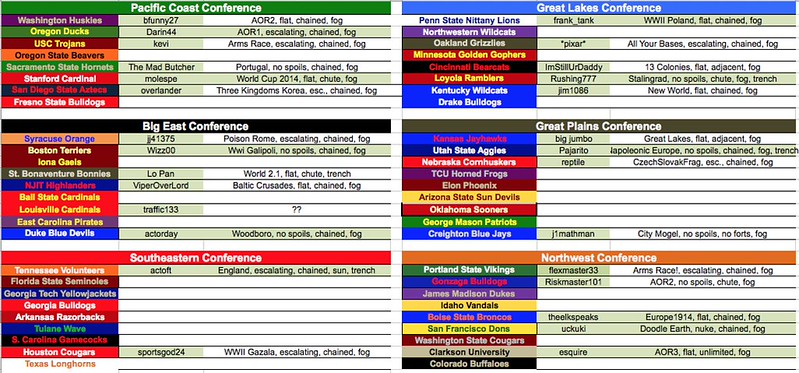 NCAAHoopsTeams by David Ball, on Flickr
(28 schools represented)