Moderator: Community Team
Post of the yearTrephining wrote:A major depression was not avoided via stimulus, TARP, bank bailouts, auto bailouts, etc. Auto companies weren't competitive, so they were handed money. They learn no lesson. Further, as part of bankruptcy proceedings, the contractual rights of bondholders were stomped on. They should have been in line ahead of the unions for proceeds from bankruptcy, and instead the unions were moved ahead of them.
Let's think practically about the implications of such an event. If you are an investor looking to part $10M in bonds, would you invest in an industry where your priority rights in bankruptcy liquidation can just be ran over when you expect them to take effect? I doubt it. So the auto bailouts created a massive reason for investors to avoid that industry, and even to avoid any US industry b/c they can't even be sure that the federal gov't won't screw them over.
You wouldn't want to play a game of Conquer Club where your opponents' friends got to change the rules of the game partway through, right?
do you have any opinion on what we got for our money, domestically?Baron Von PWN wrote:Usually when I have argued against massive US spending on the military, and it is absolutely ridiculous, it has been in the context of people talking about needing to cut government funding for other projects. I don't have anything against military spending on principle (in fact I support increased military spending in Canada as the military has been long neglected), however in the US's case I think the Military is the most obviously bloated branch of government. When you spend more than the rest of the world combined I think you are being a little excessive. Say the US were to cut their military spending to a mere 40% of global defense spending I think that would be a considerable chunk out of the deficit. The rest could be made up in other cuts elsewhere and by generating more revenue (Yes more revenue will be necessary).
I think the money might have been better spent on public works style projects rather than shoring up crappy companies. It would have given the public a visible "we're doing something!". Its difficult to get inspired or enthusiastic about financial reform and shoring up dinosaur companies.Phatscotty wrote:do you have any opinion on what we got for our money, domestically?Baron Von PWN wrote:Usually when I have argued against massive US spending on the military, and it is absolutely ridiculous, it has been in the context of people talking about needing to cut government funding for other projects. I don't have anything against military spending on principle (in fact I support increased military spending in Canada as the military has been long neglected), however in the US's case I think the Military is the most obviously bloated branch of government. When you spend more than the rest of the world combined I think you are being a little excessive. Say the US were to cut their military spending to a mere 40% of global defense spending I think that would be a considerable chunk out of the deficit. The rest could be made up in other cuts elsewhere and by generating more revenue (Yes more revenue will be necessary).
on your point, running an empire aint cheap pal!
The Guardian wrote:First of all, the enormity of the US military budget is not just down to a powerful military-industrial complex. America is a rich country. In fact, it's vastly rich. So its budget is bound to dwarf the others.


Pack Rat wrote:if it quacks like a duck and walk like a duck, it's still fascism
https://www.conquerclub.com/forum/viewt ... 0#p5349880

Pack Rat wrote:if it quacks like a duck and walk like a duck, it's still fascism
https://www.conquerclub.com/forum/viewt ... 0#p5349880
Holy f*ck.saxitoxin wrote:
... We've got children with truly dismal futures.Phatscotty wrote: Question: What did we get?
I would be comfortable with your assesment, especially about debt, if we still had a growing birthrate. I believe I remember correctly, in Keynesian speak, robust population growth accompanied by a high birthrate of citizens (for US anyhow) is a pre-requisite for Keynesian success. It has been my opinion for a while now that this is one of the main reasons for our lax border security. (among a few others). It may not be a coincidence that 2008 is also the same year US started to have a decreasing birthrate. Rich people in the know took this as a huge red flag. (more and more Americans can either no longer afford to have children, or else choose not to)nietzsche wrote:I ideologically agree with the first 5 posts. At the moment of the bailouts tho, I was totally in favor of them cause I was on the market, in a couple of stocks especially susceptive to the financial turmoil.
If I wasn't on the market, it woould've been really fun to see what it would've happen. Those greedy bastards deserved to be left by themselves. Everything is crap now anyway.
Jobs and credit were needed tho, I have no idea of how to approach that without a) debt, b)benefiting no one but the whole country or c)making the bank sector public. Once the downward spiral has started something rather specific for the zeitgeist is need it to stop it. And Obama was obviously not the solution. Quite the socialist the guy, apparently has no idea that the economy is hitting most to the poor than the rich.
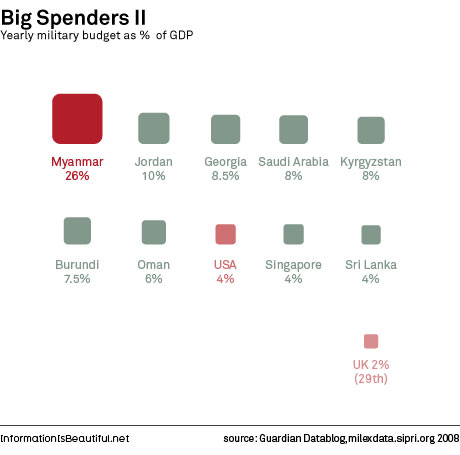
I think the most relevant thing here is just how big the US economy is. As your graphic shows the USA still only spends about 4% of its GDP. I suppose what I am saying is they could get away with spending 3% of GDP and still be top dog by a huge margin.saxitoxin wrote:Vis a vis U.S. military spending, it is relevant to note that part of the expense in maintaining American forces is the relatively generous compensation given to soldiers in the United States versus Portugal or Denmark. Or, for instance, neo-Germany, where every PFC-equivalency rank is a conscript paid slave's wages and no discharge benefits. Further, and perhaps more saliently, things just cost more in the U.S.